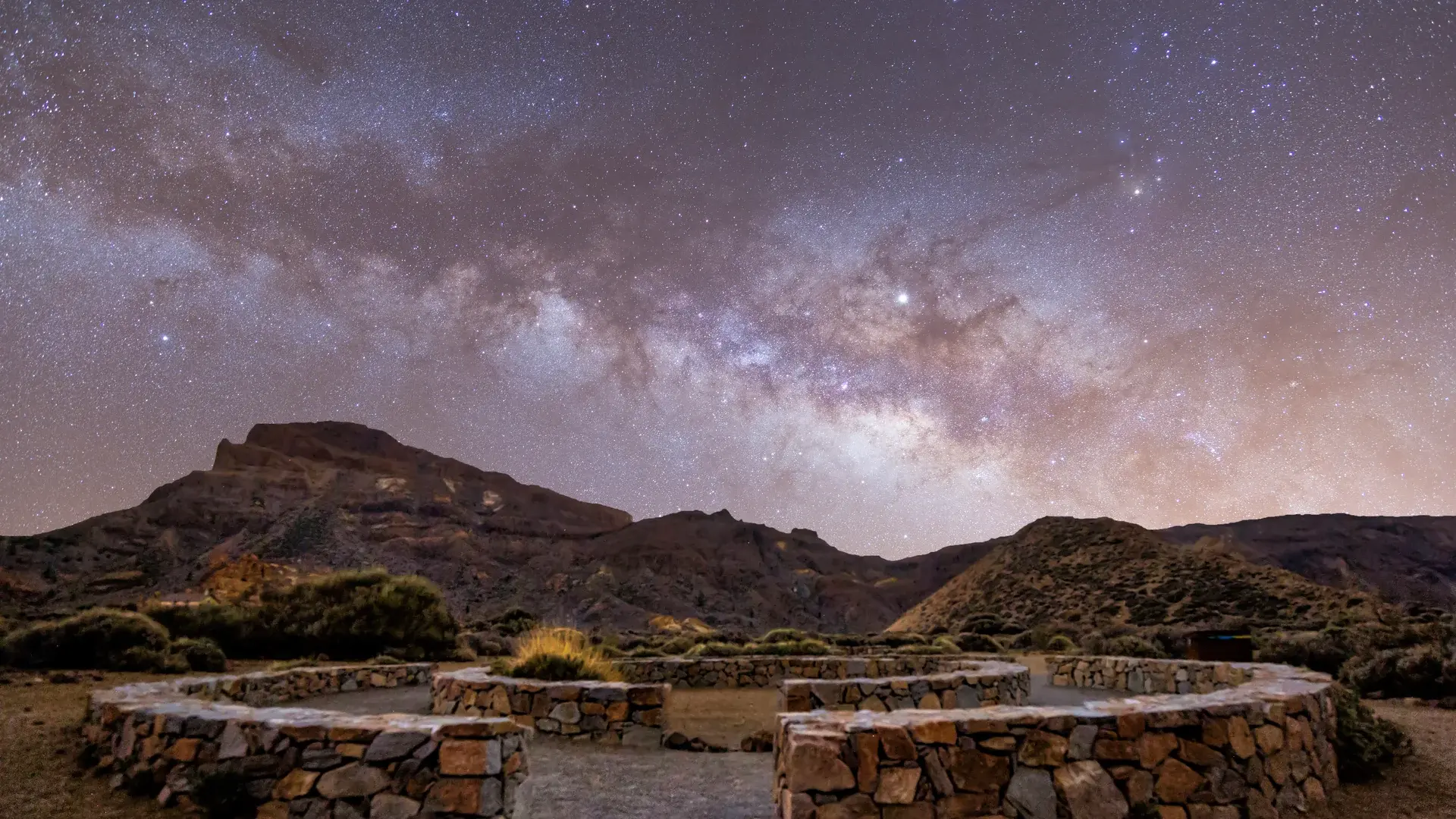
Why is the sky over Teide so dark?
Because it's high and protected as a Starlight site. The Starlight Foundation lists El Teide as a Starlight Tourist Destination and the Cumbres de Tenerife, the island's summits, as a Starlight Reserve, both since October 2013.
In the Foundation's words, a Starlight Reserve is a protected natural area committed to defending the quality of the night sky and access to starlight. A Starlight Tourist Destination is a place you can visit, with very good conditions for contemplating starry skies.
Height does the rest. AEMET, Spain's weather agency, explains that the trade-wind inversion normally sits between 800 m and 1,600 m and sets the height of the sea of clouds; the park's visitor guide puts practically all of the park above 2,000 m.
Does Tenerife have a Sky Law?
Yes, though here it doesn't cover outdoor lighting. Spain's Ley 31/1988, which protects the astronomical quality of the Instituto de Astrofísica de Canarias (IAC) observatories, applies on Tenerife to new installations that could degrade the sky.
Outdoor lighting is the exception: on Tenerife it falls outside the law, as long as it doesn't disturb the observatories on La Palma, where the law applies in full.
Can you visit the Teide Observatory?
Yes, on a booked guided visit, but it's a working observatory devoted mainly to the Sun, not a stargazing spot. The IAC's Observatorio del Teide sits at Izaña, at 2,390 m, where the municipalities of La Orotava, Fasnia and Güímar meet; its first telescope, installed by the University of Bordeaux, began work in 1964.
The IAC says its location and the transparency of its sky led to the site being reserved mainly for studying the Sun, and it hosts major European solar telescopes such as GREGOR. It also has night-time telescopes, some of them robotic.
Individuals and groups can book a guided visit; under-16s go free and residents get a discount. Each year there's also a two-day open house, with registration on the IAC's website.
How do you get up to Teide at night?
By car: four roads climb into the national park, and none of TITSA's buses goes up after dark.
From the south
The TF-21 from Granadilla, through Vilaflor, to Boca de Tauce.
From the north
The TF-21 from La Orotava to El Portillo de la Villa: 31 km.
From La Laguna
The TF-24, along the island's ridge, to El Portillo de la Villa: 30 km.
From the west
The TF-38 from Chío to Boca de Tauce.
What are the park's rules after dark?
The same as by day: the national park's list of offences doesn't single out the night. Driving off public roads and tracks, wild camping, lighting fires and playing radios or instruments loudly are all banned, and so is taking stones or plants.
The visitor guide also warns that getting lost isn't hard: stick to routes you know or that are signposted, and don't walk alone. At some times of year, parts of the park are covered in ice and snow.
Plan where to stop, too. The park's FAQ says parking inside it is very limited, with small areas by the viewpoints along the main roads and one near the Parador de Las Cañadas, and that the cable car car park closes at night. Spending the night is only allowed with an authorisation, as a bivouac in four areas, booked on Tenerife ON, the Cabildo's platform.
Is there a bus back from Teide at night?
No. TITSA's two lines into the park run once a day in each direction and leave in the afternoon, so they suit a day trip, not a sunset.
These are TITSA's every-day timetables as of 4 November 2026, in Canary Islands time.
| Line | Leaves for Teide | Leaves the park | Journey |
|---|---|---|---|
| 342 (from the south) | Costa Adeje bus station 09:25 · Los Cristianos 09:40 | El Portillo 15:15 · cable car 15:40 · Parador 16:00 | 2 h 15 min |
| 348 (from the north) | Puerto de la Cruz 09:30 · La Orotava 09:45 | Parador 16:00 · cable car 16:05 · El Portillo 16:30 | 1 h 40 min |
How cold is it on Teide at night?
Colder than you'd guess from the beach, all year round. At AEMET's Izaña station, at 2,369 m, the 1981–2010 normals give an average minimum of 1.1 °C in January and 14.0 °C in July.
The park's guide describes high mountain with an extreme climate that can change quickly, and asks for warm clothes even when it's hot. If you're heading on to a club afterwards, see what to wear for a night out in Tenerife.
| Month | Average minimum | Average maximum |
|---|---|---|
| January | 1.1 °C | 7.5 °C |
| February | 1.3 °C | 8.0 °C |
| March | 2.7 °C | 10.2 °C |
| April | 3.5 °C | 11.8 °C |
| May | 5.8 °C | 14.5 °C |
| June | 9.9 °C | 18.9 °C |
| July | 14.0 °C | 23.0 °C |
| August | 13.8 °C | 22.6 °C |
| September | 10.4 °C | 18.6 °C |
| October | 6.9 °C | 14.3 °C |
| November | 4.5 °C | 11.1 °C |
| December | 2.4 °C | 8.8 °C |
From the stars back to the club nights
One night for the sky, the others for the dance floor. The clubs in Tenerife South are between Costa Adeje and Los Cristianos, and every date on sale is in our calendar.
Staying in the north? Start with Puerto de la Cruz and Santa Cruz after dark. And for a quieter evening for two on the coast, see Tenerife nights for couples.