What is there to do in Santa Cruz de Tenerife?
A market in the morning, architecture and art at midday and a beach in the afternoon: the five stops below fill one day, and each publishes its own hours. Mornings matter, because the market closes at 14:00.
Where a cell shows a bus, the place is outdoors and has no opening hours.
| Place | What it is | Official hours or access |
|---|---|---|
| Mercado de Nuestra Señora de África | The capital’s main market | Mon–Sat 06:00–14:00 · Sun 07:00–14:00 |
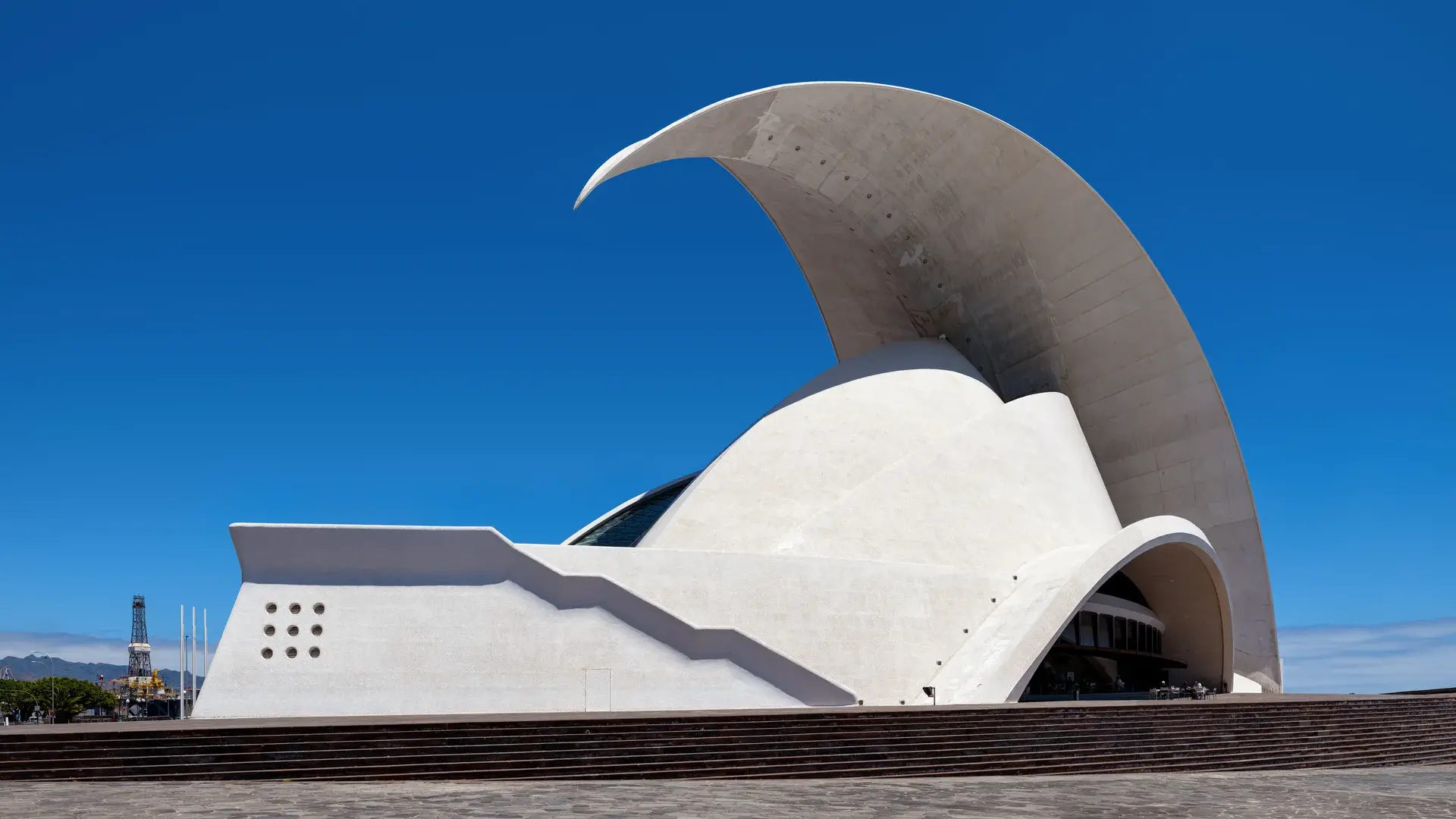
| Auditorio de Tenerife | Santiago Calatrava’s concert hall, with guided tours | Mon–Fri 10:00–17:00 · Sat 10:00–14:00 |
| TEA Tenerife Espacio de las Artes | Contemporary art, a library and a cinema | Tue–Sun 10:00–20:00 |
| Palmetum | A palm garden on a former rubbish dump | Every day 10:00–18:00 |
| Playa de Las Teresitas | The city’s beach, by San Andrés | Bus 910, 20 min |
Can you go inside the Auditorio de Tenerife?
Yes, on a guided tour, from Monday to Friday between 10:00 and 17:00 and on Saturdays until 14:00, except on public holidays. The general ticket costs €5, children under 12 go free, and the Auditorio asks you to book ahead by phone or email.
The building, officially the Auditorio de Tenerife Adán Martín, is the work of Santiago Calatrava, the architect of the city’s trade-fair centre too. It’s also a working venue with its own seasons of concerts, opera and dance, so an evening there is another way to spend a night in the capital. Rooms on the tour can change when the hall is in use.
When is the Mercado de Nuestra Señora de África open?
From Monday to Saturday, 06:00 to 14:00, and on Sundays from 07:00 to 14:00, according to Turismo de Tenerife, the island’s tourist board. It’s the capital’s main market, so go in the morning.
From there it’s a short walk to the Iglesia de la Concepción, the city’s main church, built where the island’s first chapel stood.
A walk among the sculptures: Plaza de España, the Rambla and García Sanabria
The city centre is an open-air gallery, and it costs nothing to walk it. Under the Plaza de España, by the port, an interpretation centre shows what remains of the Castillo de San Cristóbal, the first great fort built to guard the bay.
Uphill, the Rambla de Santa Cruz is a tree-lined avenue with works by Joan Miró, Henry Moore, Jaume Plensa, Martín Chirino and Francisco Sobrino. It leads to the Parque García Sanabria, the central park, which has open-air sculptures of its own.
How do you get to Las Teresitas beach?
On TITSA’s line 910, which runs every day from the Intercambiador, Santa Cruz’s bus station, past the Plaza de España to the beach at San Andrés in 20 min. The city’s official chronicler records that its golden sand was brought from the Sahara when the beach was built, from 1967 onwards.
A breakwater keeps the water calm, and Turismo de Islas Canarias lists showers, toilets, changing rooms, beach bars and a lifeguard service. Looking for Blue Flag beaches near the club nights instead? They’re in the beaches of Tenerife South.
Palmetum and TEA: a garden on an old dump and an art centre
The Palmetum is a 12 ha botanical garden devoted to palms, laid out on what used to be the city’s rubbish dump. It opens every day from 10:00 to 18:00, with last entry at 17:00, and a non-resident adult ticket costs €6.
TEA Tenerife Espacio de las Artes, the island’s contemporary art centre, opens from Tuesday to Sunday, 10:00 to 20:00, and closes on Mondays unless they’re public holidays. Its cinema shows films in their original language from Friday to Sunday, with one screening a day at 19:00.
Tram, buses and the way back to the south
Line 1 of the tram links Santa Cruz with La Laguna: on weekdays it runs from 06:00 until midnight, and at weekends and on public holidays it runs non-stop, through the night. The direct bus 100 reaches Puerto de la Cruz in 40 min: see what to see in Puerto de la Cruz.
Back to the south by day, TITSA’s line 111 takes 90 min from the Intercambiador to the Costa Adeje bus station. At night, the all-night 711 and the late runs of the 110 do the trip: their times are in Santa Cruz carnival nights, which also covers the city’s best-known festival.
For the capital after dark outside carnival, see Santa Cruz and Puerto de la Cruz by night; the club nights on our calendar are in Tenerife South.